


We are committed to protecting your personal data and providing you with access to your personal data in accordance with the personal data protection laws in force in the European Union.
By clicking "Accept All", you are giving us permission to place cookies to enhance your experience on this website, to help us analyze site performance and usage, and to allow us to deliver relevant marketing content. You can manage your cookie settings below. By clicking "Confirm" you agree to the current settings.
2026-10-07
Blog
A Practical Guide to Retiring EN 469 Firefighting Clothing
EN 469 firefighting clothing is designed to protect firefighters during demanding operations. However, its protective performance can decline over time due to heat, flame, contamination, repeated use, cleaning, and general wear.
There is no single retirement date that applies to every garment.
The most important question is:
Can the garment still provide reliable protection?
If the answer is uncertain, it should no longer be used for operational firefighting.
Age Is Not the Only Factor
EN 469 does not define one fixed service life for all firefighting clothing.
A garment’s usable life depends on:
- How often it is used
- The conditions it has been exposed to
- The severity of heat or flame exposure
- Cleaning and storage
- Its inspection and service history
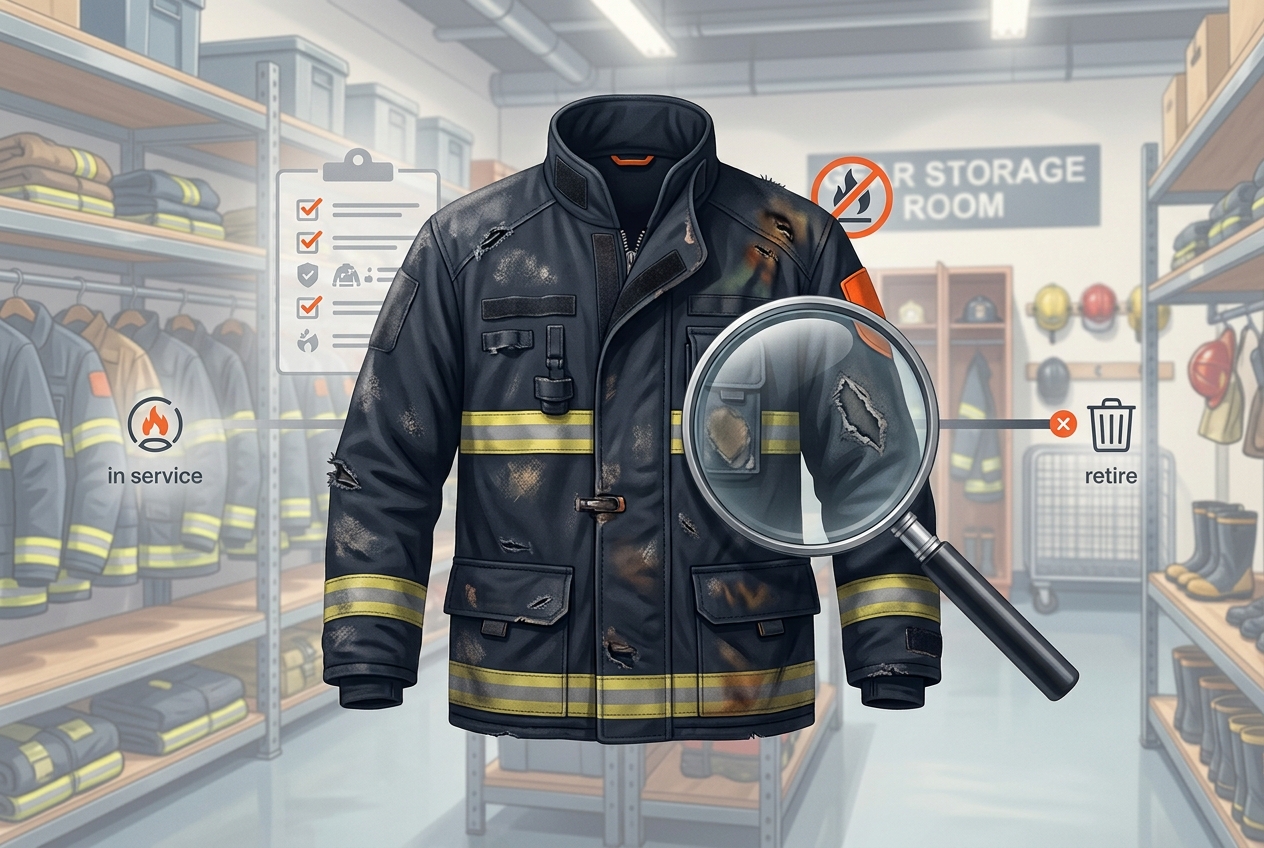
Signs That a Garment Should Be Retired
Visible Damage
Retirement should be considered when the garment has:
- Tears, holes, or open seams
- Severe abrasion or thinning
- Burn marks or heat damage
- Melted, hardened, brittle, or deformed areas
- Damaged closures or adjustment systems
- Missing or damaged visibility features
Loss of Fit or Shape
The garment should be retired if it has excessive shrinkage, permanent distortion, restricted movement, or no longer fits correctly with the rest of the protective ensemble.
A poor fit may leave parts of the body less protected and make it more difficult for the firefighter to move safely.
After Extreme Exposure or Serious Contamination
The garment should be inspected after:
- Direct flame contact
- Severe heat exposure
- Flashover or similarly extreme conditions
- Chemical exposure
- Heavy abrasion or mechanical stress
It should be retired when contamination remains after approved cleaning, when the contaminant is unknown, or when continued use may create a health risk. A garment that looks clean is not necessarily free from hazardous contamination.
Uncertain Condition or History
A garment should not remain in operational use if its condition cannot be properly verified. This may occur when:
- The label is missing or unreadable
- The certification or size cannot be confirmed
- Inspection records are unavailable
- Its exposure history is unknown
- Its protective condition cannot be assessed
Conclusion
EN 469 firefighting clothing should be retired when it can no longer be trusted to provide reliable protection. The decision should be based on its condition, exposure history, contamination, fit, and inspection results—not on age alone.