
Functionality
Enhanced Cuff Closure System
In real operational conditions, the wrist–glove interface is exposed to more heat, moisture, and runoff than most people expect. When water travels down the sleeve or when steam builds up around the arms, this area becomes a natural collection point. Even a minor gap can allow discomfort—or in worse cases, risk—to reach the wearer. Because of this recurring challenge in field use, the wrist remains an important part of the garment’s protective performance.
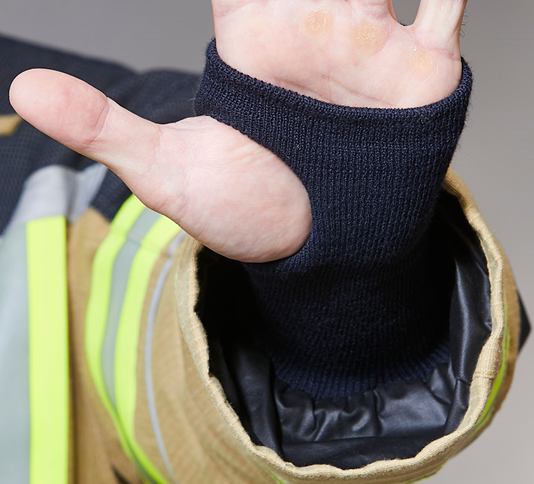
The Enhanced Cuff Closure System was developed with that practical reality in mind. Beneath the outer shell and moisture barrier, a coated sealing layer is incorporated to create a more stable closure around the wrist. Its role is straightforward: help minimize the pathways through which hot liquid or vapor could enter during movement, tool handling, or extended reach.
During evaluations, users noted that the wrist area behaved more predictably under wet and high-temperature conditions, which is especially relevant for garments seeking to meet EN 469 Y2 requirements on liquid penetration resistance.
This design strengthens protection at a point known for operational vulnerability, while maintaining the flexibility and comfort expected in modern firefighting gear. It is a focused improvement, but one that contributes meaningfully to the overall reliability of the protective system.
The Enhanced Cuff Closure System was developed with that practical reality in mind. Beneath the outer shell and moisture barrier, a coated sealing layer is incorporated to create a more stable closure around the wrist. Its role is straightforward: help minimize the pathways through which hot liquid or vapor could enter during movement, tool handling, or extended reach.
During evaluations, users noted that the wrist area behaved more predictably under wet and high-temperature conditions, which is especially relevant for garments seeking to meet EN 469 Y2 requirements on liquid penetration resistance.
This design strengthens protection at a point known for operational vulnerability, while maintaining the flexibility and comfort expected in modern firefighting gear. It is a focused improvement, but one that contributes meaningfully to the overall reliability of the protective system.
