


We are committed to protecting your personal data and providing you with access to your personal data in accordance with the personal data protection laws in force in the European Union.
By clicking "Accept All", you are giving us permission to place cookies to enhance your experience on this website, to help us analyze site performance and usage, and to allow us to deliver relevant marketing content. You can manage your cookie settings below. By clicking "Confirm" you agree to the current settings.
2026-04-15
Blog
The Invisible Frontline-Part 2: The Toxic Pathway
Exposure & Cross-Contamination Pathway
We uncovered how carcinogens like PAHs stubbornly anchor deep within firefighting gear fibers.
While your firefighting suit protects you during the blaze, a silent chemical threat lingers.
The danger lies in the "Transfer."
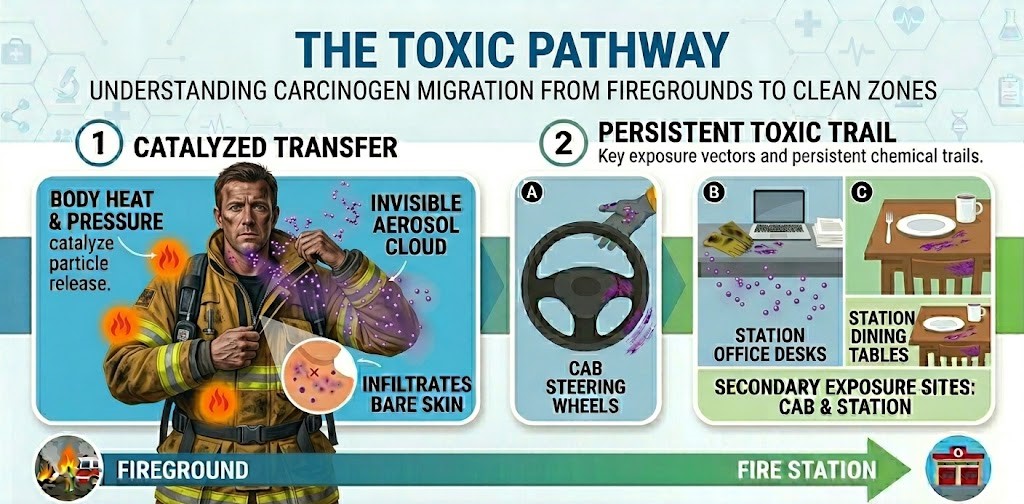
During doffing, physical manipulation—bunching or pulling at soiled fabric—dislodges trapped particles, creating invisible aerosol clouds that can infiltrate bare skin immediately. Crucially, industry research indicates that stubborn molecular residues remain deeply embedded within the inner layers. During doffing, body heat and physical stress act as catalysts, forcing these trapped particles to migrate toward the surface and into invisible aerosol clouds that infiltrate bare skin immediately.
Before professional decontamination, this soiled gear often touches steering wheels, office desks, and dining tables, leaving a persistent toxic trail in "clean" zones.
This effectively turns the truck cabin and station into secondary exposure sites. Understanding how toxins migrate from the field to the station is the critical first step in protecting you.
We uncovered how carcinogens like PAHs stubbornly anchor deep within firefighting gear fibers.
While your firefighting suit protects you during the blaze, a silent chemical threat lingers.
The danger lies in the "Transfer."
During doffing, physical manipulation—bunching or pulling at soiled fabric—dislodges trapped particles, creating invisible aerosol clouds that can infiltrate bare skin immediately. Crucially, industry research indicates that stubborn molecular residues remain deeply embedded within the inner layers. During doffing, body heat and physical stress act as catalysts, forcing these trapped particles to migrate toward the surface and into invisible aerosol clouds that infiltrate bare skin immediately.
Before professional decontamination, this soiled gear often touches steering wheels, office desks, and dining tables, leaving a persistent toxic trail in "clean" zones.
This effectively turns the truck cabin and station into secondary exposure sites. Understanding how toxins migrate from the field to the station is the critical first step in protecting you.