


We are committed to protecting your personal data and providing you with access to your personal data in accordance with the personal data protection laws in force in the European Union.
By clicking "Accept All", you are giving us permission to place cookies to enhance your experience on this website, to help us analyze site performance and usage, and to allow us to deliver relevant marketing content. You can manage your cookie settings below. By clicking "Confirm" you agree to the current settings.
2026-03-16
Blog
The Breathability Paradox: Mastering the Golden Balance
The Precision Engineered Balance
Think of the Ret value as the "breathing resistance" of your fabric assembly.
The lower the number, the easier it is for your sweat to escape.
Normally, people push the limits to keep Ret values low, ensuring you can stay active longer without your core temperature redlining.
But here’s the interesting twist: Is more breathability always better?
Not necessarily. There is a delicate technical paradox at play. If a suit is designed to be too breathable without a robust thermal shield, it creates a dangerous pathway.
Imagine extreme external heat forcing its way through those same "breathable" pores. It can flash the sweat on your skin into high-pressure steam instantly.
This is the nightmare of every firefighter: Steam Burns.
While international standards, EN 469 mandate a multi-layer structure including a moisture barrier and thermal liner—to prevent this exact scenario, simply having these layers isn't enough. It's about how you engineer them.
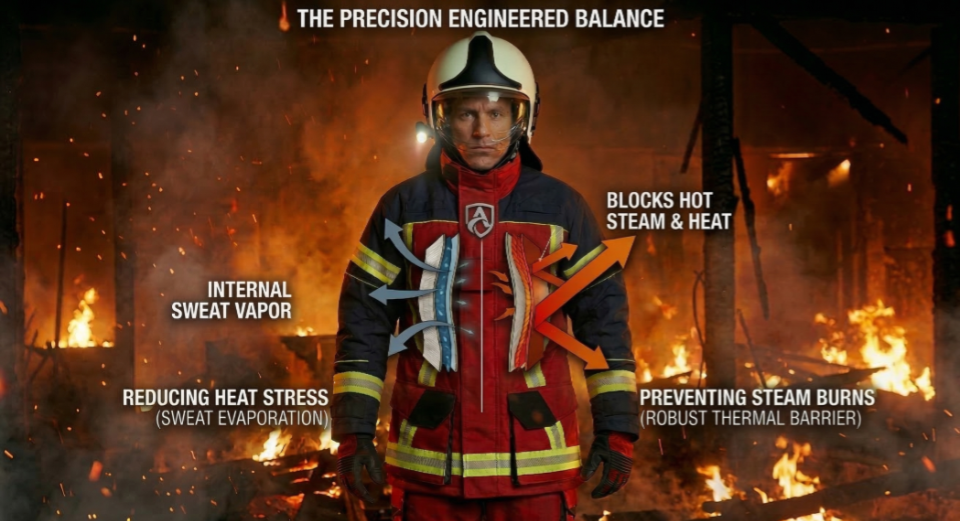
Think of the Ret value as the "breathing resistance" of your fabric assembly.
The lower the number, the easier it is for your sweat to escape.
Normally, people push the limits to keep Ret values low, ensuring you can stay active longer without your core temperature redlining.
But here’s the interesting twist: Is more breathability always better?
Not necessarily. There is a delicate technical paradox at play. If a suit is designed to be too breathable without a robust thermal shield, it creates a dangerous pathway.
Imagine extreme external heat forcing its way through those same "breathable" pores. It can flash the sweat on your skin into high-pressure steam instantly.
This is the nightmare of every firefighter: Steam Burns.
While international standards, EN 469 mandate a multi-layer structure including a moisture barrier and thermal liner—to prevent this exact scenario, simply having these layers isn't enough. It's about how you engineer them.
Optimizing Selective Breathability: Every standard moisture barrier acts as a gatekeeper, but we ensure our microporous membranes are perfectly calibrated. They aggressively block external high-temperature steam from invading, while keeping the internal escape route wide open for your sweat vapor.
Precision Engineering in the Thermal Liner: To prevent sweat from flash-boiling, the thermal liner must provide a balanced buffer to absorb and delay external heat energy, without obstrcting the moisture escape pathways.
At Super Armor, we ensure you stay cool on the inside, without ever compromising your defense against the scalding heat on the outside.
Precision Engineering in the Thermal Liner: To prevent sweat from flash-boiling, the thermal liner must provide a balanced buffer to absorb and delay external heat energy, without obstrcting the moisture escape pathways.
At Super Armor, we ensure you stay cool on the inside, without ever compromising your defense against the scalding heat on the outside.