


We are committed to protecting your personal data and providing you with access to your personal data in accordance with the personal data protection laws in force in the European Union.
By clicking "Accept All", you are giving us permission to place cookies to enhance your experience on this website, to help us analyze site performance and usage, and to allow us to deliver relevant marketing content. You can manage your cookie settings below. By clicking "Confirm" you agree to the current settings.
2026-03-04
Blog
Why the EN ISO 6530 "Gutter Test" is Your Shield Against Overlooked Chemical Splashes
The Danger You Don't See
When you enter a fire scene, your eyes are on the flames. But beneath the smoke, there are invisible risks: leaking fuel and batter acid from a car wreck or spilled industrial solvents on a factory floor. These are the overlooked chemical splashes that can compromise your safety. If your turnout gear absorbs these liquids, it increases the risk of steam burns, and can even ignite under extreme heat.
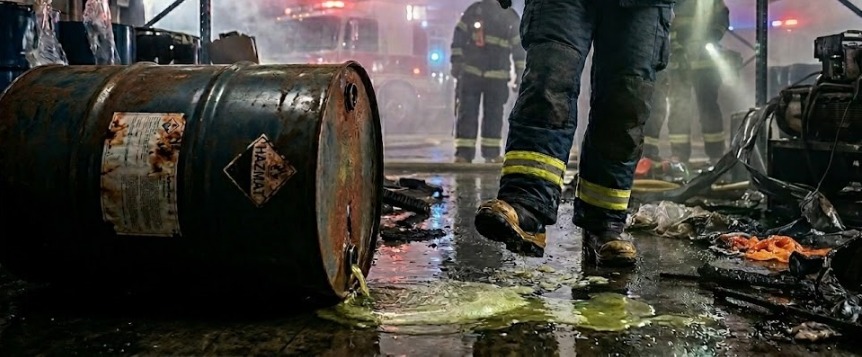
When you enter a fire scene, your eyes are on the flames. But beneath the smoke, there are invisible risks: leaking fuel and batter acid from a car wreck or spilled industrial solvents on a factory floor. These are the overlooked chemical splashes that can compromise your safety. If your turnout gear absorbs these liquids, it increases the risk of steam burns, and can even ignite under extreme heat.
The Science of the "Gutter Test" (EN ISO 6530)
EN ISO 6530 standard, commonly known as the "Gutter Test."
This laboratory procedure is the scientific benchmark used to validate your fabric's defensive capabilities:
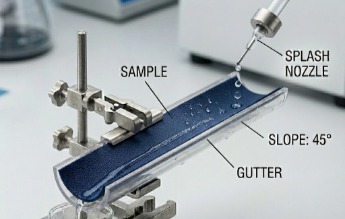
Simulating Action: The fabric is placed in a semicircular gutter inclined at 45° to simulate the creases and folds that naturally form in your sleeves and trousers. This steep angle forces the liquid to flow across the fabric, proving that even in the deep bends of your gear, hazardous spills will bead up and roll away instead of soaking in.
The 10ml Challenge: Discharge 10ml of hazardous chemicals, including corrosive battery acids (H₂SO₄) and industrial solvents (o-xylene) onto the surface to see how the material reacts in real-time.
The Validation of Repellency: This test proves whether liquids will soak into the fibers or—as we intend—bead up and roll away instantly. The fabric must achieve a Repellency Index of > 80% with ZERO penetration. This precision ensures that over 80% of toxins are instantly discharged while virtually no liquid reaches your skin.